
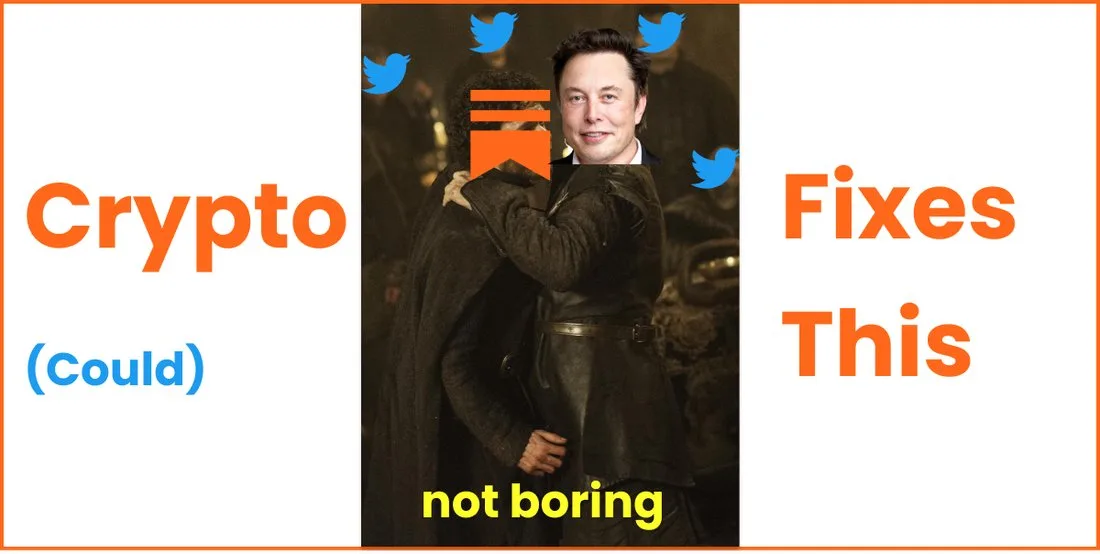
One way to think about crypto is as an insurance policy.
You pay for it, kinda hate it, pay for it, hope you never need it, pay for it… and then PHEW.
It’s not the sexiest sales pitch for a new technology, but this is a bear market after all. And over the past few months, I keep seeing things that make me whisper to myself, so no one else hears… “Crypto could fix this.”
Take Twitter.
Last Thursday, as we were preparing the Weekly Dose and dropping in Twitter links which magically turned into Twitter embeds like we always do, we got hit with this popup:
I thought it was an API issue, because I’m a sap who assumes the best in people. Then on Friday morning, I hopped on to Twitter to discover that any tweet including a link with “substack.com” in it couldn’t be liked or retweeted. My fellow Substackers were in shambles. I’d share their tweets to show you, but tweet embedding is still down.
Elon hasn’t given an explanation, but you don’t need to be Enola Holmes to get to the bottom of it. On Wednesday, Substack introduced Notes, and Notes looks an awful lot like Twitter.
Of course, Elon paid $44 billion to own Twitter and can do what he likes, but what he likes has certainly turned out to be a bummer for those of us who rely on the platform for our livelihoods.
When you have a hammer, everything looks like a nail, so imagine me saying this with the utmost humility and the least bravado possible, but… crypto could fix this.
This kind of situation – the kind in which one person or a small group of people can make decisions that hurt users, developers, or partners on a whim – is exactly the kind of situation that crypto’s advocates have been building to prevent.
Specifically, decentralized social protocols like Farcaster and Lens have been doing a lot of hard, unsexy work, and building products that so far look a lot like Twitter, to ensure that future social networks can make certain guarantees to its users and developer partners that no one person or small group of people could violate.
As Farcaster co-founder Varun Srinivasan wrote in Sufficient Decentralization for Social Networks, “A social network achieves sufficient decentralization if two users can find each other and communicate, even if the rest of the network wants to prevent it,” which “can only be true if developers can build many clients on the network.”
On any given day, for any given user, this is a hard value proposition to grok. Twitter, Facebook, Instagram, Snap, and TikTok work just fine for the vast majority of users most of the time.
The problem with Twitter, however, from the perspective of anyone trying to build anything on top of it, be it an app or an audience or a relationship, is that on any given day, Elon could wake up in a mood and decide to change the rules.
Decentralized social is Elon Insurance.
Decentralized social networks can provide that insurance because they separate the protocol and the clients, let the ecosystem govern the protocol, and encourage anyone to build a diverse set of clients on top of it.
The protocol – the service that stores users names, keeps the social graph, lets people post to the network – progressively decentralizes once it’s good enough in order to become a stable public good on top of which developers can build any number of more centralized clients. Those clients – the equivalent of the Twitter app, the part of the product that users interact with, that manages feeds, algorithms, interfaces, moderation, and more – can be as opinionated as they’d like to be, and anyone is free to build one however they’d like.
Take the Substack situation, the Orange Wedding.
On decentralized social, the protocol would store all of the user names, handle the relationships among users, and let people send tweets (with links, images, and more) would be set practically in stone and really hard to change, like a public good or Hyperstructure. All of the innovation would take place at the client level.
There might be one client on which all Substack links and mentions are blocked and another that only shows tweets that include Substack links and mentions, both pulling from the same protocol.
In Back to the Future of Twitter, Ben Thompson proposed something similar, breaking Twitter into two companies: TwitterAppCo (client) and TwitterServiceCo (protocol).
But even that architecture runs into the Elon Problem. As Thompson wrote (emphasis mine), “A truly open TwitterServiceCo has the potential to be a new protocol for the Internet — the notifications and identity protocol; unlike every other protocol, though, this one would be owned by a private company. That would be insanely valuable.”
“This one would be owned by a private company” puts us right back in the same spot. If Elon were in charge of the protocol, as Thompson proposed, he could feasibly scrub substack links and tags from the database.
A sufficiently decentralized protocol, on the other hand, would need the majority of its token holders to wake up feeling petty in order to do the same thing, or even more if big changes required some sort of supermajority. Scanning Twitter over the weekend, it doesn’t seem like a majority would back that kind of decision.
Crypto could fix Twitter, or at least prevent it from happening at the next generation of social products. It’s one of those applications of the technology that only becomes apparent when things break. I’ve seen a bunch of those recently.
When I saw the Taylor Swift / Ticketmaster debacle, the one where scalpers and bots got most of the tickets she wanted to sell to her real fans, I thought, “Crypto could fix this.” Specifically, NFTs seem like they could be useful insurance against scalpers by letting fans prove their fandom through Music NFTs owned, POAPs from concerts attended, official fan club NFTs and more. Ticketmaster actually seems to kind of agree. They recently rolled out an NFT-gated ticket sales experiment with Avenged Sevenfold.
When SVB collapsed, leaving companies without access to their funds over a harrowing March weekend, I thought, “Crypto could fix this.” Specifically, the ability to self-custody at least a portion of funds the same way people once kept cash under their mattress seems like decent insurance against bank runs. I’m not rooting for a collapse of the banks or expecting BTC to hit $1 million any time soon, but “People should be able to access and use their money whenever they like” doesn’t seem like a crazy proposition.
And if AI really is as powerful a technology as it seems like it’s going to be, I think crypto could be a very useful insurance policy against unprecedented centralization of power – imagine if Elon ran OpenAI instead of Sam Altman – and against the verification challenges to come. As Joe Weisenthal wrote, “A Solution to Twitter’s Bot Problem is Staring at Us Right in the Eyes.” Specifically, zero-knowledge proofs will be a valuable counterpart to AI, to say nothing of the governance and ownership mechanisms that have been cooked up in crypto’s laboratories over the past few years. Plus, I really don’t think people will want to have their wife deleted by some Trust & Safety PM at Microsoft. I suspect that the free market with crypto tools will do a better job of figuring out positive sum solutions to the challenges presented by AI than the government or any six month pause will.
Obviously, crypto is not popular right now. It’s a non-starter in many conversations. There’s a lot of work to be done to improve both the image and the infrastructure, so that entrepreneurs and CFOs are able to use the technology in some of the ways we’ve discussed today without raising eyebrows on their boards and among their users.
Put another way, if you told people not, “You should use crypto” but, “I have this brand new technology called Zoop or whatever and here’s what it does,” and then listed crypto’s feature set, they would say, “Wow, that’s actually super useful and exactly what I’m looking for” and adopt the technology. We shouldn’t throw the benefits out with the bathwater.
Look, if you view 2023 as some sort of End of Tech and Business History, nothing I’ve written here will be particularly compelling. Twitter’s network effects are really strong. The banking industry is the banking industry. Many have tried to take down Ticketmaster before, and just as many have failed. And if anyone’s going to control the most powerful technology ever, Sam Altman seems like as good a person as any.
If you’ve read Not Boring for a while, though, you know that’s not how I view 2023. I think we’re still at the starting line, that the technology that awes us today will look laughably primitive when Dev and Maya are my age, and their kids will make fun of them for the dinosaur tech they used. There will be new social networks, monopolies will fall, banks will continue to fail, and AI will only get smarter and more useful.
In that view of the world, it’s worth the short-term headache and expense to build systems that are robust and fair over the long-term.
I remain excited about all of the fun use cases of crypto — the upside stuff — and think that crypto’s ability to turbocharge network effects (with the right design) will only get more important as abundance accelerates and other sources of power fade. But I’m also coming to realize that the downside protection is equally valuable. The most important applications might be the ones we don’t want to have to use.
The world is full of people who would act like Elon if given the chance, and the way things are today, those people are often given the chance. Crypto could fix this.