
Substack’s Strategy and Me
So why a separate homepage? Maybe the #1 rule of building an online business, which I’ve written about many times, is that nothing is more valuable than owning your own demand. Substack has a few limitations that make that challenging, which makes sense! To Substack, as an aspiring aggregator, I’m supply, and you’re demand! So they’d rather have you come to notboring.substack.com than to my own site.
Substack needs to strike this fascinating balance between putting newsletters first and putting Substack first. In many cases, they choose to put Substack first. That’s not a criticism -- Substack is a business and it needs to make the strategic decisions that it thinks are best for the long-term health of the company. But it does lead to a few limitations that make growing from 1,885 to 5,000 difficult:
Branding and Design: Substack is intentionally simple and non-customizable. Standard layouts, San Serif font, character limited intros, etc. If you’re Substack, this makes sense. Including the “.substack.com” in all links and keeping a consistent look and feel has helped turn “Substack” into a synonym for “newsletter” in a short amount of time.
As a writer, though, outside of voice, there’s not a lot of ways to distinguish and brand yourself on Substack. Here’s all of the visual customization I’m able to do:
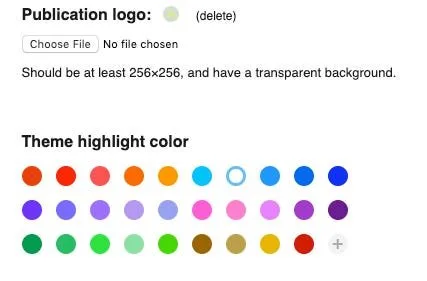
Luckily, Spectral, the font everyone uses on Substack, is a great font, but if I wanted to use Comic Sans, I’d be out of luck. Substack isn’t alone here; Medium is also totally uncustomizable. While my focus is always the words, I also want to create a unique brand and aesthetic for Not Boring. Looking exactly the same as everyone else is … boring.
A homepage lets me express some of those brand quirks and promote unique messaging and posts from Not Boring that otherwise are difficult to discover for first time readers.
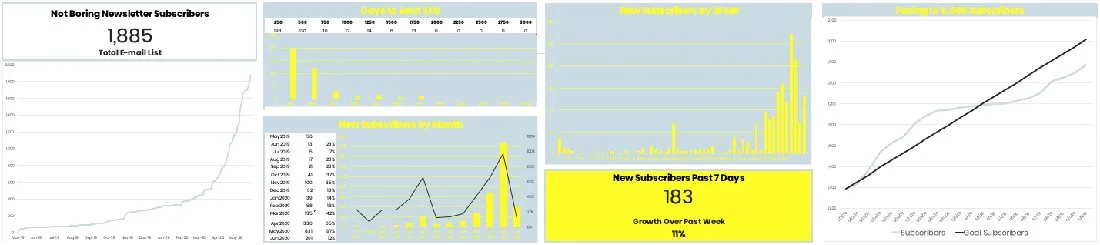
Reporting: Substack doesn’t offer great reporting and analytics to writers. I guess they think we’re words people, not numbers people. If you love geeking out on data as much as I do, though, you’re not going to have a good time on Substack. Outside of the number of subscribers and high-level reporting on referral channels, there’s not a lot to dig into. This makes it hard to go full CSI on conversion and understanding what’s driving new subscribers to Not Boring. It’s also why I built my own dashboard in Excel.


Growth and Integrations: The biggest gap right now for newsletter writers with Substack is the lack of integrations, because integrations would solve other challenges. If you want to launch a referral program, sweepstakes (free jet ski anyone?), or other promotional programs, it’s basically impossible to launch and track on Substack. And I do want to launch those things… stay tuned.
Each of these programs require precise tracking, and Substack’s closed ecosystem simply doesn’t support foreign pixels or javascript. Again, from Substack’s perspective, this makes sense. It keeps newsletters clean and consistent, and it makes writers more reliant on Substack for growth once they build out those capabilities in the future. Plus, their focus is on high-quality, subscription content, so opening up the ecosystem to outside tooling, including programmatic ad insertion, doesn’t fit in their vision.
But I’m impatient to grow this thing, so I had to get creative.
SEO: Since Not Boring is just a Substack subdomain, I don’t own any of my own search engine optimization (SEO) juice. Whenever someone links to a post I write, it boosts Substack’s searchability, but not necessarily mine. If I ever decide to leave Substack, I can take my list with me, but all of the link juice I’ve built up stays behind. I want to build a long-term brand with Not Boring, so I need to own my SEO.

Again, I’m a huge fan of Substack and the simplicity of the product. I’m not moving off of Substack, just building on top of it. I know they’ll get there over time and I’m hopeful that projects like this prove to them the need to iterate and provide unique growth levers for their community. And they’ve been responsive in the past. Nathan and Dan launched the Everything bundle by hacking it together on top of Substack, and then Substack built tools to make it easier to bundle.
The Stack
Now let’s talk about the Honda Civic of tech stacks I’ve put together for the homepage.
Domain name from Google Domains ($20/ year). After weeks of user testing and brand workshops, I finally landed on the domain name “Notboring.email”. The URL narrowly beat out the likes of “Notboring.global”, “Notboring.guru”, and “Notboring.pizza”. I tried to buy notboring.com but the owner wasn’t interested in selling. Honestly for the best, that site is a rare piece of late 90s internet memorabilia and it should stay on the internet.
Landen.co landing page + hosting ($29/ month). I’ve seen Landen used by a bunch of entrepreneurs launching landing or “Coming Soon” product pages. The product is incredibly simple to use and implement, and has the perfect amount of design customization for no-coders. Collectively, it only took me a few hours to create and launch the site, and most of that time was put into messaging and content. There are a few limitations on the integration front, but I’ve become besties with their one man customer support team (Felix Gurtler, founder). I tested a few other landing page tools, and I’m convinced Landen provides the best balance of affordability, function, and design for a newsletter writer. I’m a fan!
WisePops integration (free trial + $49/ month). Everyone loves pop ups, right? I wanted to make the call to action super clear on the landing page, and pop ups are annoyingly effective at grabbing people’s attention.
Like so many things that we hate online, pop-ups exist because we’re dumb humans and the things we hate often work on us.
The Wisepop integration allows me to display an email capture when someone scrolls 50% down the page and hasn’t subscribed. I’m hopeful it’s a good way to keep the action top of mind and drive conversion. I’m doubtful I’ll see an ROI at the $50/ month, but decided to implement it with the free trial to see how many submissions come from the pop up vs. the Landen subscribe field.
Zapier Integration (free). Unfortunately you can’t connect Landen or Wisepop with Substack (see: lack of integrations - not even Zapier! Everything integrates with Zapier!). That means that every email submitted on the landing page has to be manually migrated to Substack. To minimize the back and forth, I’ve built a Zapier integration with Gmail that sends a welcome email from me anytime someone signs up for Not Boring on the homepage, which looks and feels just like the HTML Substack email. I’ll just have to manually migrate emails over to Substack before I send my Newsletter on Monday and Thursday. Not the smoothest process, but should work well enough for now. Landen does integrate directly with Mailchimp, but I’m not interested in switching email providers (yet).
Crisp Chat (free). Ever had the urge to spark up random convos with me over chat? Well now you can! I’ve launched a community messaging tool. It’s basically hosted Slack on my homepage, and you all know how much I love Slack. I’m not sure how useful this will be, but it provides an opportunity for new readers to ask questions about the newsletter or for community members to reach out to me directly. More to come whether it’s valuable, but it’s free for less than 2 users, and the best companies are always customer obsessed.
Tracking Pixels (free) - Landen supports a bunch of different tracking tools including Google Analytics, Facebook Pixel, and Google Tag Manager (which can effectively host any tracking pixel on my page). This will allow me to launch ad campaigns and track customer acquisition costs (CAC) by channel/ campaign/ etc. I want to track cost per action (CPA) for subscriber sign ups, and Landen provides the ability to implement more granular reporting.