🎶 It’s the most funniest time of the yearrrrr 🎶
It’s that time of year when people like me fire up their laptops, open a blank Google doc, look back on everything that’s happened over the past year, and boldly extrapolate into the next.
We mainly use the opportunity to pump our bags, financial or otherwise. “You know that thing that I care about / write about / invested in?” we ask. “Well, that thing is going to be even bigger and more important next year.”
And we’re almost always wrong. Or at least, we’re not right enough and definitely not right precisely.
Imagine confidently typing up predictions for 2020 at the end of 2019. Best case, they looked good for about two months. “We write annual prediction emails and God laughs.”
I didn’t even land within an order of magnitude of my predictions for myself when I set goals in Per My Last E-mail #23 on January 1, 2020: “Get to 1,000 subscribers and build a community.”
By the end of 2020, though, I had the benefit of knowing that COVID was a thing, and of spending nearly an entire year just writing, investing, and talking to smart people. Surely, my 2021 predictions were spot-on, right?
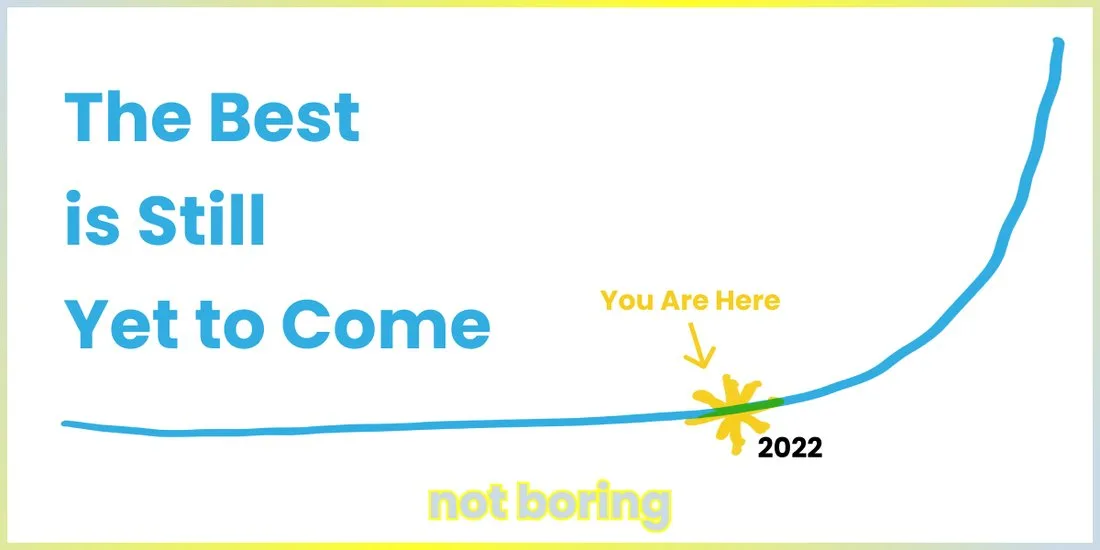
Ehhhh… In The Best is Yet to Come last December, I highlighted three themes that made me bullish on the year ahead in tech:
The Markets Are Eating Up Technology. Bubble or not, more funding would lead to more innovation.
Cloud Companies. Remote work + liquid work + software would make it easier to spin up and grow companies with the best people from around the globe.
The Passion Economy Writ Large. More people would start working for themselves, and more self-employed people would make the economy more resilient to future shocks.
I’m as optimistic as they come. I literally started that piece by writing: “I’ve always been an optimist. It’s how I’m wired. My brain has a very hard time visualizing the downsides, and a very easy time visualizing the upsides.”
And still, somehow, I wasn’t optimistic enough. I missed web3.
In 2021, crypto, NFTs, DAOs, and DeFi hyperturbosupercharged each of the themes that I thought were going to shape 2021. A year later, those crypto-less predictions seem quaint.
The Markets Are Eating Up Technology. Last year, I mainly wrote about the equity market’s insatiable demand for tech stocks. I missed that web3 would create a global, liquid market for everything from culture to the Constitution.
Cloud Companies. Remote is here to stay, and entrepreneurs can spin up companies faster than ever thanks to the availability of better and better software primitives. I fell short though, by not anticipating the rise of DAOs, the Great Resignation, or the full force of the Cooperation Economy.
The Passion Economy Writ Large. I wrote about the potential of passion economy platforms like TikTok, Discord, Substack, and OnlyFans, but I missed creators’ ability to build direct economic relationships with fans and shift from labor to capital. I also missed just how big an umbrella the word creator covers. Power to the Person.
All to say, if I missed the biggest game changer of 2021 in my predictions last December, you shouldn’t take any of my 2022 predictions this December very seriously. So I won’t make any, other than this:
If you thought that 2021 was wild, 2022 will make it look normal.
Over the past year, everything in our corner of the world got bigger, faster.
Prior to 2021, venture funding never reached $100B in a single quarter. This year, it’s exceeded $100B every quarter. Q2 and Q3 each saw $160B in venture funding.
In January, 99.9% of us had never heard the letters NFT next to each other. Now, $13.7B worth of NFTs have traded hands on OpenSea alone this year.
Last year, the US was out of the Paris Agreement and climate change seemed like an intractable problem that was going to take a miracle to fix. After Chris Sacca’s interview with Harry Stebbings on 20VC, it feels like entrepreneurs are going to “unfuck the planet” through innovation and make a ton of money for their contribution.
Play-to-earn gaming exploded onto the scene with Axie and holds the potential to give millions of people new ways to earn a living.
Civilians have gone to space so many times this year that I almost missed it when Blue Origin flew Michael Strahan to space last week.
For better or worse, the Metaverse went from something that a handful of nerds (🙋🏻♂️) talked about to something that everyone is talking about.
Fintech continues to steal share from the big banks and expand the market, healthtech is starting to show signs of fixing healthcare, and API-first companies are making it easier for new companies to focus on solving untouched challenges.
Web3 has proven that it’s much more than just Bitcoin, and given builders a new toolkit for aligning incentives and distributing ownership.
The list goes on. As Josh Wolfe points out, the gap between SCI-FI and SCI-FACT keeps shrinking.
This is just the beginning. 2021’s accomplishments will become 2022’s primitives, the lego blocks with which entrepreneurs build bigger and more impactful products. “Discoveries become inventions become building blocks become inventions become building blocks, ad infinitum.” That’s the nature of Composability.
It’s also in composability’s nature to be unpredictable. It’s impossible to predict exactly what people are going to create with the primitives – software, hardware, and ideas – at their disposal. The distributed hive mind of millions of entrepreneurs will dream things up that no one person could. But it’s easy to predict that they’ll build increasingly useful and valuable things, solve previously unsolvable problems, and dream up solutions we didn’t even know we needed.
All to say, there’s reason to be optimistic. I’ve spent the last year plus at Not Boring trying to lay out the rational case for optimism, for why, regardless of short-term volatility, things will continue to trend up from here. Optimism has been the financially dominant strategy for at least the past two decades, and I want us to sound smart, too:
Now, “be more optimistic” isn’t particularly actionable advice on which to end the year. Being optimistic shouldn’t just mean sitting passively by and waiting for good things to happen. But how do you orient and act in a world that’s moving and evolving so quickly?
I’ve written about Worldbuilders a lot here – people who predict something non-obvious about the way the world is moving, create a seemingly small wedge into a much larger opportunity, timestamp their vision, and then execute patiently but aggressively to make it a reality. The worldbuilders we’ve covered are people like Elon Musk, Jeff Bezos, and the founders of unicorn startups, but I think the same thing works for regular people like us.
Formulate a decade-long view of where everything is heading, where you want it to head, and what role you’re best-suited to play in making that happen.
This past year was a blast. People jumped from project to project, from mint to mint, from DAO to DAO. It was a year during which experimentation was the purpose. It was a lot of fun.
But, at least for me, it also meant that there was less time to think longer-term and to get more deeply involved in a few projects working towards things that will take more than a few weeks to play out. As things move faster and faster, it’s more and more important to hit pause, evaluate, and plan.
Personally, I’m going to read a lot, write thoughts not meant for public consumption, put some systems in place, and try to anchor myself to a longer-term vision of where the world is heading and how I can best contribute.
That will be a loose guide. When the madness starts back up in January, I’ll try to act like a Bayesian, tethered to my priors but updating my understanding and approach as I receive new information. That’s why I’m not making any annual predictions: a year is both too short and too long a time frame for me to have conviction.
So I’m not setting anything in stone, but I think that having a longer-term view will help me pick and choose among the myriad paths that spring up every day. I’ll probably say “yes” to fewer things next year, but go in more deeply on those yeses.
Each of your approaches will be totally different. Many of you are probably already working towards that thing you want to come true in a decade; maybe you need a little more experimentation to keep yourself fresh. Others know that you’re not doing what you want to be doing; it’s probably time to evaluate, adjust, and start taking steps towards changing that. Some, like me, are doing too many things and might benefit from a more stable north star.
Whatever you do, approach all of the novelty out there with an open mind. You can be skeptical, of course, but be curiously skeptical. Don’t default to cynicism, and don’t dismiss new things out of hand.
New things will seem weird at first, and then those weird things will seem normal, and other, newer things will seem weird, and on and on.
At some point – it might be March 2022, December 2029, or April 2069 – everything that we’ve created and experienced in 2021 will seem quaint and antiquated. If we’re lucky, today’s most out-there ideas and technologies will be tiny building blocks in much larger structures.
Of course there will be failures along the way. If there aren’t, we’re not dreaming big enough. You can choose to point to each stumble and yell, “I told you so!” or you can choose to zoom out, applaud the experimentation, and chip in where you can to make the next one better.
You know which one I’m choosing. I have no idea what the next year will bring, but I know that on a long enough time horizon, we’re going to keep pushing out the Pareto Funtier, fix the planet, and make life better for as many of the eight billion of us as possible. That’s what humans do.
The best is still yet to come.