Ryan Delk used to begin Primer’s investor updates with a “Tweet-Length Summary”:
“Closed x partnership. Shipped y product. Increased conversion z%.”
That was how he was doing it when Not Boring Capital first invested in the company in late 2021, and when I wrote a Deep Dive on the company in April 2022:
The product was growing so the updates were good. They were good in the way a lot of startups’ updates are good. Build a thing, grow a thing, optimize a thing.
The plan back then was to offer kids online Clubs where they could follow their interests and meet other curious, ambitious kids outside of school. Kids would go to whatever school they went to during the day – good, bad, mediocre – and then after school and on the weekends, they’d pull their curiosity out of the locker and log into Primer.
Long-term, Primer always expected to build Microschools, like the one Ryan’s mom created for him and his siblings when he was growing up in Florida, but that was eventually, once Primer had used software to acquire customers who were potential students at zero customer acquisition cost (CAC). Then, maybe, you’d start to offer something in-person as an extension of the online community the kids had come to love. The sequencing made sense. It got me.
The allure of Clubs was the allure of any social software product: tap into the internet’s scaled niches to build network effects at scale, then expand from there.
And it was going really well. It was growing. Kids loved Primer’s Clubs.
One time, Ryan got an email from a mom who said that her child “had not told her that she loved her in four years” until she found Primer, joined the Clubs, met other kids who shared her interests, and for the first time in four years told her mom that she loved her. The mom “literally recorded a video and sent it to me through tears explaining this,” Ryan told me.
Another time, two other kids asked their parents if they could go to San Francisco for spring break so they could visit the Primer offices. Then they … did. They hung out at the Primer offices all week.
That’s the kind of customer love most startups would kill for. And Primer had it.
Then Primer killed Clubs.
Not because they weren’t working; because no matter how well they worked, they weren’t going to solve the real problem.
On a walk with a friend, Ryan told me, “[The friend] just looked at me and was like, ‘Why would you not just go after the absolute hardest version of this problem immediately?’”
Good point. So he did. Primer started running actual schools, competing with a public school product that, while many parents were unhappy with it, was state-supported, Lindy, and free.
Since then, Ryan has begun every Primer investor update with a reminder:
“This is a civilizationally-important problem and we are willing to go to war to solve it.”
That’s not what you write when you’re selling Club software. It’s what you write when you’re trying to rebuild a system that has no intention of being rebuilt.
I was wrong about Primer in the way I was wrong about a lot of companies back in 2020-2022, and in the way I think a lot of investors are still wrong: I thought that software (a clearly superior business model) was a better approach than rebuilding the entire product, atoms and all. That you might really be able to solve the problem with software.
And I’m writing about it now because Primer’s evolution mirrors both the evolution of what startups think they’re capable of doing and how I think about companies, which goes something like this:
One vertically integrated startup willing to compete with incumbents to fix the actual problem is worth 1,000 startups writing software to improve this or that little problem on the margin.
If you want to fix energy, you need to build lots of nuclear reactors and install lots of batteries.
If you want to fix space exploration, you need to build your own rockets.
If you want to fix air travel, you need to build fast fucking planes.
If you want to fix housing, you need to build more houses.
And if you want to fix K-12 education, you need to build schools.
For two school years, that’s what Primer has been doing.
Primer partners with teachers in local communities and gives them the tools they need to start their own schools. They help them find a space – a church, a community center, any space that isn’t in use during the day (Primer recently pushed legislation through in Florida to dramatically expand the locations zoned for schools) – handle all of the paperwork to get them up and running, give them software to run the schools, and provide a core curriculum for students to follow.
Whereas Primer’s software used to be student-facing, most of it is now teacher-facing. This is a big shift, and it meant making big changes on the team side. Now, the goal is to use software to enable teachers to provide the best possible education for the lowest possible cost.
Cost is an important factor when you’re competing against free. In Florida and Arizona, where Primers exist today (Primer is announcing another state soon), parents can use their state’s school choice program to offset much of the cost of school. These programs are growing both in terms of the number of states offering them and the size of the programs, something I’ve seen first hand as an investor in Odyssey, which helps state governments administer their school choice programs. (For those getting mad just reading the words “school choice,” watch the video.)
As school choice dollars grow and Primer’s costs shrink, something critically important happens.
In our conversation, Ryan announced for the first time that, “We will have 100% free Primers live in August of 2026. So zero tuition, no out-of-pocket tuition for parents, just use the state scholarship.”
At free, Primer is the same price as public school, and its goal is to offer a higher-quality education that continues to improve – top quartile today, top decile soon – and costs less and less to serve.
This is the Vertical Integrator mantra: better, faster, cheaper, at higher margins. Primer is applying it to a $1.5 trillion US education market ($870 billion of which is spent on public elementary and secondary schools) – a gargantuan market whose impact as a multiplier on all other markets is even larger.
In its first deck, Anduril wrote “Anduril is a company that will save Western civilization by saving taxpayers hundreds of billions of dollars a year as we make tens of billions of dollars a year.”
Primer is pursuing that same promise in education – if it can provide kids with a better education at scale for a third or less of the cost of the traditional public school system, it will save our youth by saving taxpayers hundreds of billions of dollars a year as they make tens of billions of dollars a year.
That seems overly optimistic if you view Primer in the context of traditional EdTech companies, which despite their lofty missions have generally failed to produce generational companies. But if you think about Primer as a company whose top line approaches the budgets of US public school systems at high and growing margins, it tracks.
Today, Primer owns a minuscule percentage of the overall market. There is much work to be done – technological, operational, and pedagogical – to even scratch that opportunity. And given the turning tides for school choice in America, there will be plenty of legitimate competition (not to mention a flood of “competition” from standalone AI tutors, a seeming threat we discuss in the conversation). Education will not be a winner-take-all market, and it shouldn’t. But there will be a biggest winner, and my bet is that Primer will be it.
Ryan told me that Primer is making three bets:
That there will be a Moore’s Law for Education: that software will help deliver a better and better education for a lower and lower cost.
That teachers can be excellent entrepreneurs: Primer is relying on teachers in local communities to attract students and provide them with a great education.
That it’s possible to scale physical schools quickly with asset-light real estate: that by skipping the high CapEx and long timeline buildouts both public and private schools undertake, Primer can move faster and cheaper and focus on the thing parents actually care about: teaching their kids.
To me, this is one bet, and it’s the thesis against which I’ve invested in Primer two more times since that initial 2021 investment:
It is possible to build a better school system, one that gets better and costs less over time. To do that, you need to build something that looks like the existing school system, but that has some of the scale and financial characteristics of a technology business.
That’s what Primer is building. It offers physical schools. Its teachers teach a core curriculum in the morning, and then give kids the freedom to pursue their curiosity in the afternoon. As states pay more in scholarships and Primer lowers costs, it can offer a product that is free to customers at growing margins. Using technology but not defined by it, Primer can offer students an education that gets better as Primer grows, until it can provide a better education for any family that wants one.
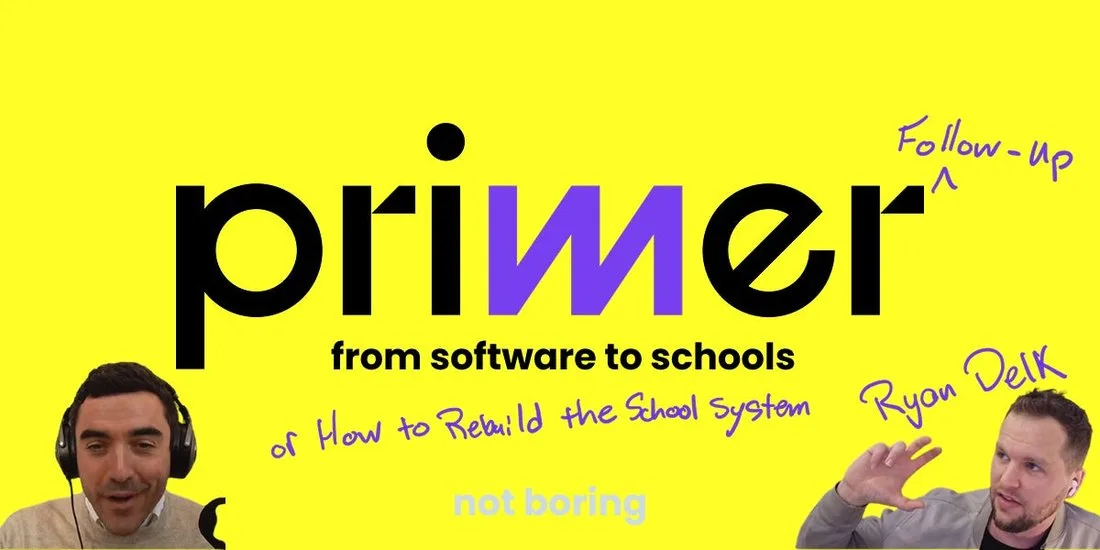
Which sounds great on paper, but which is really, really hard in practice. Ryan and I discuss those challenges and the tremendous opportunity in our Follow-Up Conversation.