
On the first full day of Donald Trump’s second presidency, the returning President assembled three men in the Oval Office for the announcement of a $500 billion plan to ensure America’s AI supremacy: The Stargate Project.
Two, Masa and Sama, were exactly two of the men you’d expect. The third was Larry Ellison.
Trump introduced Ellison as “the CEO of Everything,” which sounds like an instance of the hyperbolic tendency that the two men share, but is directionally true. The 80-year oldnb once again finds himself back at the center of the future. Or, rather, has put himself back in the center of the future.
Ellison’s Oracle (Oracle Corp, NYSE: ORCL) is a 48 year old, 500 billion dollar company, which appeared seemingly out of nowhere to become one of the four players behind the biggest AI investment of the decade.
In 2024, Oracle’s stock rose over 50%, beating Amazon (+17%), Apple (+18%), Google (+7%), and Microsoft (+9%). Ellison, the company’s founder and still its CTO, is the 4th richest man in the world.
And he just keeps showing up in the middle of everything.
Last summer, Ellison’s son, David, took over Paramount through a merger with his company, Sundance, made possible in large part by a $6 billion contribution by Ellison père.
In November, America’s top-ranked quarterback recruit, Bryce Underwood, flipped his commitment from LSU to Michigan. Ellison, whose 5th wife Jolin is a Michigan grad, picked up the check.
In January, the same week Stargate was announced, when President Trump was figuring out how to keep TikTok running in America under American ownership, rumors swirled that Oracle was his preferred buyer. Which makes sense, because all the kids love the Oracle Suite of Products.
What gives?
The last time most people in tech heard about Oracle was when they sued Google over the Java API in 2010, which eventually led to a US Supreme Court decision which determined that implementing an API constitutes fair use.
This kind of jockeying over IP, especially in the mid-2010’s when open source, open standards, and open platforms were all the rage, cemented Oracle’s (not entirely undeserved) reputation as a company more interested in litigation and vendor lock-in than innovation.
Indeed, by the 2010’s Oracle looked to be losing. After leading the way in enterprise databases and integrated software for years, competing fiercely for market share, Oracle missed three successive waves in computing: the internet, mobile, and finally, the cloud.
While Oracle was able to continue earning money from its extensive enterprise and government contracts which were locked in for years, and was able to hang on to relevance by using its distributional advantage with its existing customers to ship Oracle versions of emerging platforms and software, by 2016 things looked pretty grim. Oracle had ceded much of cloud to AWS, and Microsoft had started to muscle in with its own customer relationships to Fortune 500s and governments.
While still a titan, Oracle’s lack of innovation seemed to predict a steady slide into irrelevance. Yet over the last few years, the company has made a stunning comeback, somehow indispensable to the biggest players.
The straightforward business reason is that Oracle effectively positioned itself through massive investment in GPU datacenters to become one of the go-to players for training large language models, especially among its government and large enterprise customer base. The early miss on cloud also turned out to be an advantage, as AWS, Microsoft, and Google chose Oracle as a neutral service provider to help run their AI-focused datacenters.nb
Given the enormous investments in AI being made across the board, Oracle’s positioning has allowed it to capture a lot of value doing what it does best; large, long-term sales and services contracts with big players. The 90’s are back.
But the straightforward business reason is narratively boring. Instead, it’s much more interesting to understand Oracle as an extension of Larry Ellison’s will.
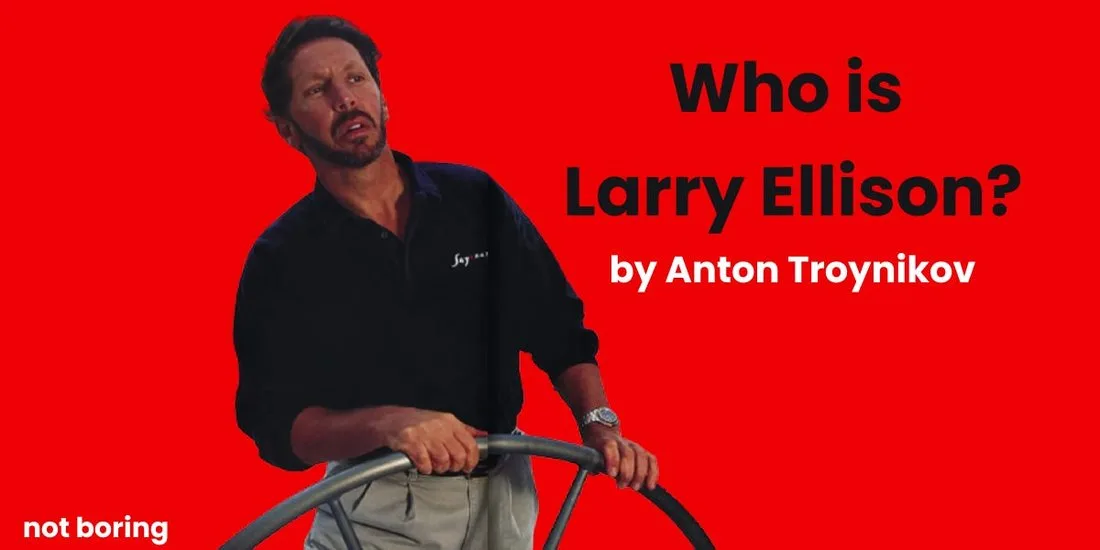
So who is Larry Ellison? Despite increasing public interest (for various reasons) in the emerging class of powerful tech billionaires, Lawrence Joseph Ellison seems to remain relatively quiet. Reportedly a close friend and mentor to Elon Musk, the 80 year old Ellison has led a colorful life, though has lately stayed out of the media spotlight.
To the extent that Oracle is an extension of Ellison’s will, Oracle’s fortunes reflect his leadership. My favorite history of the company, “Softwar”, gives the impression that the lifecycle of Oracle has gone as follows:
Larry Ellison has an insight which leads to a breakthrough initiative which has the potential to reposition Oracle to the forefront of the industry, completely bypassing the competition.
It works.
Larry Ellison checks out to go sailing or play tennis or something for like a year.
Oracle gets into trouble. New entrants and existing competitors are eating away at its market share, and Oracle is losing head-to-head.nb
GOTO 1.
For example, in the early 90s, Oracle faced stiff competition from several fast-growing software companies. At the time, enterprise software was heavily customized by the end-user, and third party integrators who would munge together several ‘best of breed’ packages to create frankenstinian hodge-podges of software, one solution per organizational function or process. It was a nightmare for everyone but the vendors and integrators, who made money either way.
Rather than competing on features, or cost, or attempting to create more best-of-breed products, or pay ever fatter sales commissions which ate away margins, Ellison chose to tell his customers that they were doing it wrong.nb Software shouldn’t be built to fit business processes, he said, business processes must adapt to software. Vertically integrated platforms were the future.nb
Getting everything from one vendor meant you didn’t need customization or integration, things would just work. Yes, it meant changing the way you were used to doing things, but that’s what it took to get the most out of software. It just so happened that the vendor investing the most into this vertical strategy was Oracle. The move to vertically integrated platforms locked in Oracle’s distributional advantage for another decade.nb Between 1990 and 2001, Oracle’s revenue went from $196M to $10 billion.
Tacking before competitors may have come naturally to Ellison, a lifelong sailing enthusiast. In the 2010 America’s Cup, Oracle-sponsored USA-17 defeated Swiss Alinghi 5. This gave the winning team the right to decide the class of boat for the 2013. Making an already expensive and dangerous sport far more expensive, and far more dangerous, Team Oracle chose wingsail catamarans, with hydrofoils.
These boats could literally sail faster than the wind. The change was far from incremental; sailing teams were pushed to their absolute limit in terms of cost and training. A crew member from Artemis Racing died during a training run. Team Oracle USA went on to win the 2013 America’s Cup. (Fun fact: I watched them do it from the Presidio, and it was incredible to behold).nb
Even Softwar itself says more about Ellison than just what’s in the content of the text itself. It’s the only biography or business history I’ve ever read where the subject inserted his own footnotes,nb many of which contradict the author. For example:
Author:
Ellison ‘showed up in shorts and a pink tank top, holding a glass of carrot juice,' recalls former Oracle vice president Mark Barrenechea of his first meeting with the man.
Ellison Footnote:
LE writes: I met Mark out on my deck just as I arrived back home from the gym. I was wearing a black cotton tank top with a Sayonara logo on it. I have never owned, nor would I ever wear, a pink tank top. This is very important.
One can only imagine the kind of ruthless negotiation over completely non-standard terms in publishing that Ellison must have conducted.
Larry Ellison is out to win, in a way that goes beyond playing the game on the field. When Ellison is threatened with falling behind, he changes the rules to turn weakness into strength. When he’s ahead, he changes the rules to put himself even further ahead.nb nb
Oracle seemed to ‘come out of nowhere’ because Ellison saw how to pivot a miss in cloud into a winning position in the next computing wave, AI. Now Oracle finds itself exactly where it's most comfortable: selling expensive, long-term contracts to big enterprises and governments. The 90s are indeed back, and Larry Ellison wrote the playbook.
Ellison took a losing position, pivoted, caught up, and made it look like that’s what he meant to do all along. So when Trump introduced Ellison as 'the CEO of Everything' in the Oval Office, it wasn't hyperbole. It was recognition that once again, Larry Ellison had changed the rules of the game until they benefited Larry Ellison.
The only surprise is that we're still surprised.